
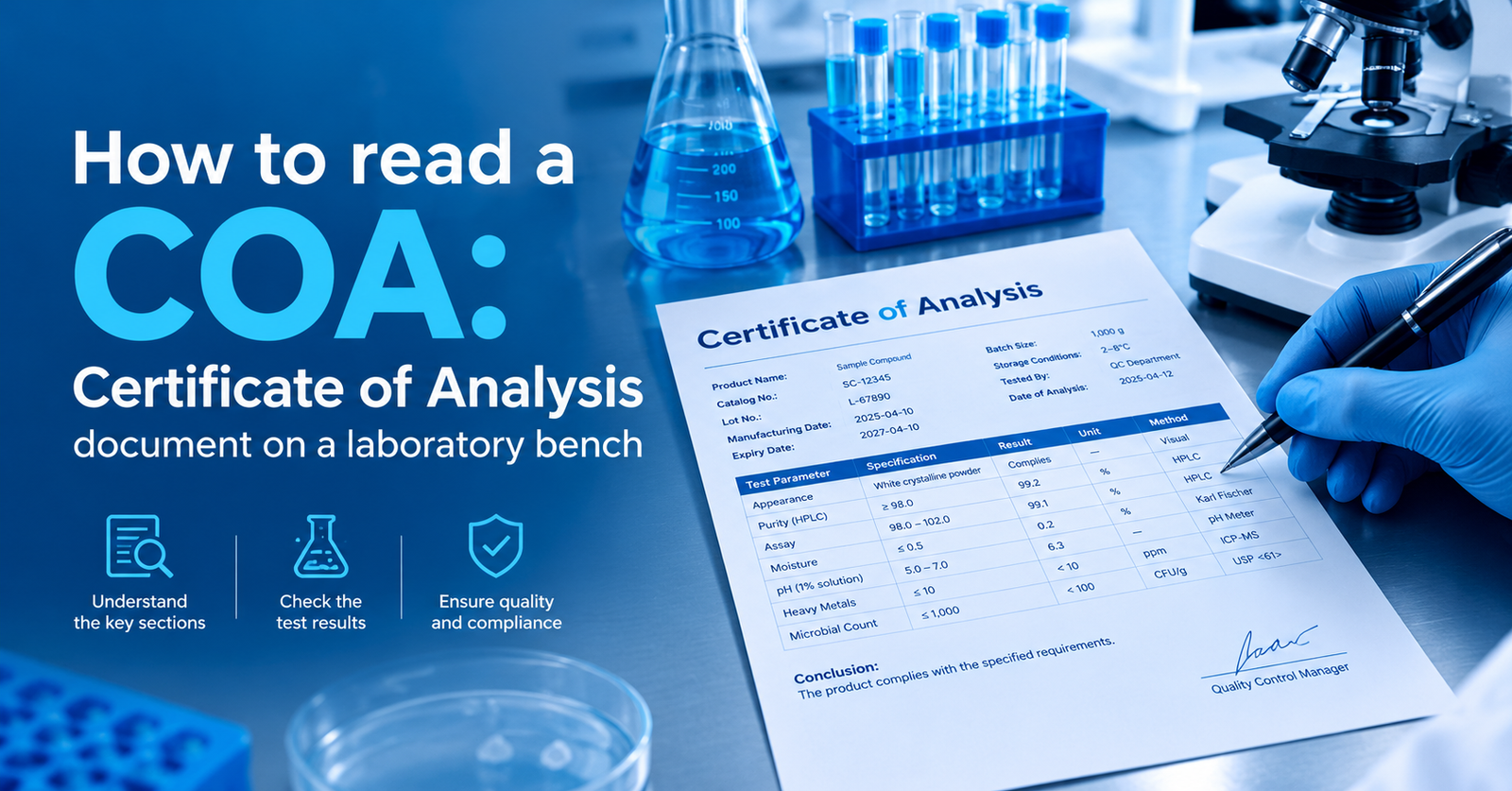
A Certificate of Analysis, usually shortened to COA, is the most useful document a research supplier can give you. It records what was tested, which methods were used and what the results were. If you know how to read one, you can judge a supplier and a lot in a few minutes.
What a Certificate of Analysis is
A COA is a report for one specific lot of material. It is produced after the lot has been tested and it describes the results of those tests. It is not a general brochure about the product, and it is not a promise about anything beyond the laboratory. A good report is specific, dated and tied to a lot number.
Step 1: Check the basics
Start with the product name, the lot number and the test date. The lot number on the report must match the lot number on your vial. If it does not, the report does not describe your material. Also check that the test date is reasonable for the lot you received.
Step 2: Look at the methods used
A real COA names its methods. For research peptides the most common are high-performance liquid chromatography (HPLC) for purity and mass spectrometry (MS) for identity. A report that only gives a purity number with no method is hard to trust. If you want a plain-language explanation of the first method, read our guide to how HPLC measures peptide purity.
Step 3: Read the purity result
Purity is normally the percentage of the sample that is the target peptide. If the report includes a chromatogram, look at it. One tall, sharp main peak is a good sign. Many peaks of similar size suggest the sample contains other components. A stated purity should be supported by the chromatogram, not just printed as a number.
Step 4: Confirm identity with mass spectrometry
Purity tells you how much of the sample is one component. It does not tell you what that component is. Mass spectrometry measures the molecular weight of the material. The measured value should match the expected weight for the peptide, within normal instrument tolerance. Together, HPLC and MS answer two different questions: how pure is it, and is it the right compound.
Step 5: Check who ran the test
The report should name the laboratory and carry a date. Be cautious if the laboratory is not named, if there is no date, or if the document looks like a template with details filled in by hand.
Step 6: Look for storage and form details
Many reports also state the form of the material (for example, a lyophilized powder), the amount in the vial and the recommended storage conditions. These details help you handle the material correctly. For general guidance, see our article on storage and handling basics.
Red flags on a COA
- No lot number, or a number that does not match your vial
- A purity figure with no method and no chromatogram
- The same report used for different lots
- A missing laboratory name or test date
- Results that look rounded or identical across unrelated products
A quick checklist
- Lot number matches the vial
- Test date is present
- HPLC method and chromatogram are included
- Mass spectrometry confirms the expected molecular weight
- The testing laboratory is named
Conclusion
A good COA is specific, dated and tied to your lot. At MICROGRAMBIO, the report for every lot is published on its product page so you can review it before you order. You can read more about how we test on our Quality and testing page, or browse the research catalogue.
For laboratory research use only. Not for human or animal consumption.
See the report for any lot before you order
Every MICROGRAMBIO lot is published with its Certificate of Analysis.
Browse the catalogueQuality and testing