
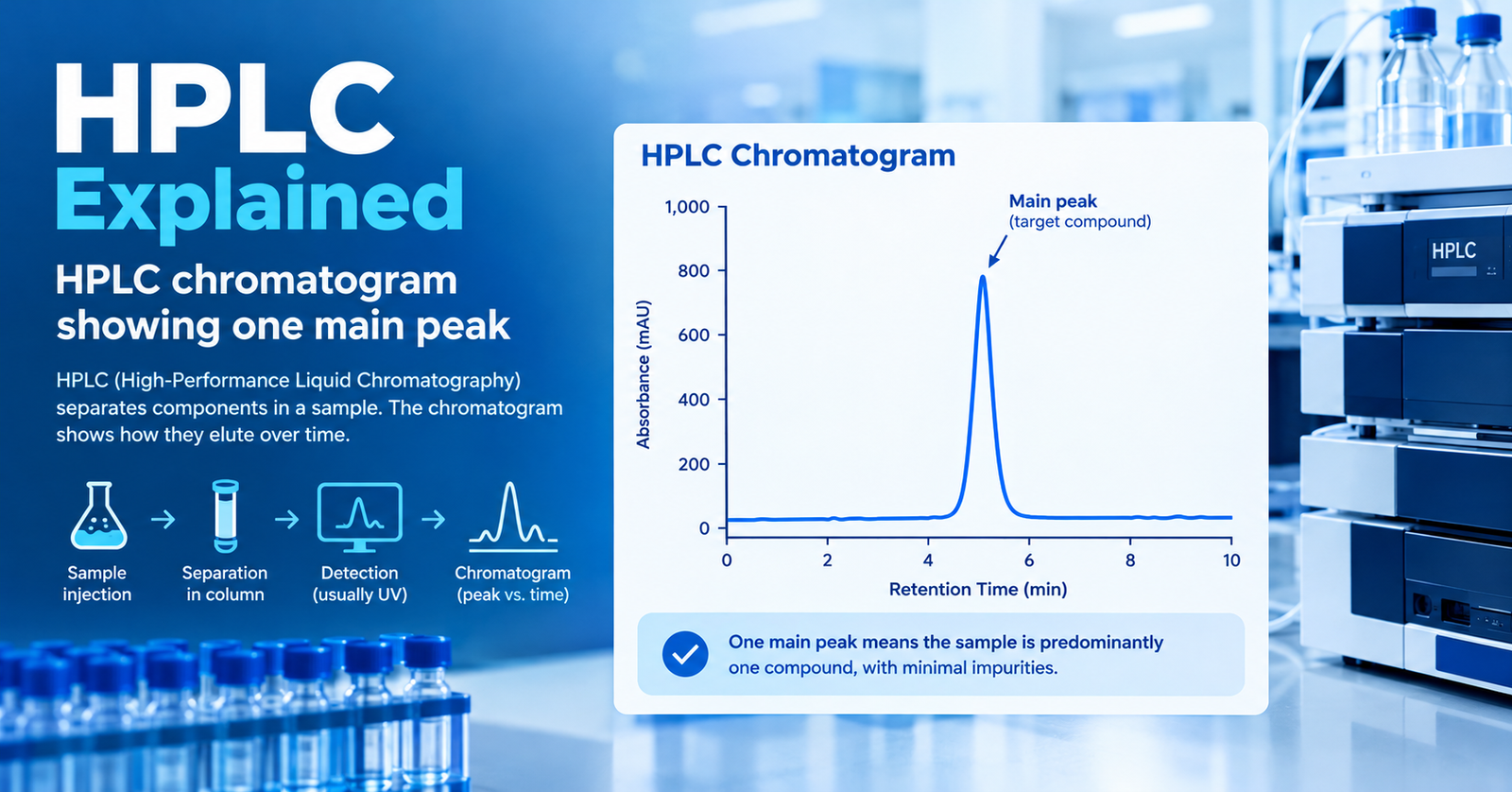
High-performance liquid chromatography, or HPLC, is the standard method for measuring the purity of a research peptide. The name sounds technical, but the idea behind it is simple. This guide explains how it works and how to read the result.
The basic idea
A sample is dissolved in a liquid and pushed under pressure through a column packed with very fine particles. Different molecules interact with those particles to different degrees, so they travel through the column at different speeds. They leave the column one after another, and a detector records each one as a peak.
What a chromatogram shows
The result is a graph called a chromatogram. The horizontal axis is time and the vertical axis is the detector signal. Each peak represents a component of the sample. In a good peptide sample, one tall, sharp peak stands out and the other peaks are small.
How purity is calculated
Purity is usually reported as the area of the main peak divided by the total area of all peaks, shown as a percentage. A higher percentage means more of the detected material is the main component. The calculation depends on the method, so a report should state the method, the column and the detection settings.
Why retention time matters
The time at which a peak appears is called its retention time. Comparing it with a reference helps confirm that the main peak is the compound you expect. A retention time that shifts a lot between lots, without a stated reason, is worth questioning.
What HPLC cannot tell you on its own
HPLC tells you how much of a sample is one component. It does not prove what that component is. That is why a complete report pairs HPLC with mass spectrometry, which measures molecular weight and supports identity. Read more in our guide to reading a Certificate of Analysis.
Common questions
Is 99% purity always better than 98%?
Not necessarily. The number only means something when the method is stated and the chromatogram supports it. A well-documented 98% is more useful than an unsupported 99%.
Why do reports differ between suppliers?
Laboratories can use different columns, gradients and detection wavelengths. That is why the method matters as much as the figure.
Does HPLC detect everything?
No. It detects components that respond to the detector used. Some impurities may need other tests.
What to look for in a report
- A sharp, dominant main peak
- A stated method and detection settings
- A report tied to a specific lot number and date
- A mass spectrometry result alongside the HPLC data
Conclusion
HPLC is a clear, reliable way to measure purity when it is documented properly. To see how it fits with the other tests we run, visit The science behind research peptides and Quality and testing.
For laboratory research use only. Not for human or animal consumption.
See the report for any lot before you order
Every MICROGRAMBIO lot is published with its Certificate of Analysis.
Browse the catalogueQuality and testing